 简体中文
简体中文 English
Panoramic Ultra-Narrow Soundproof Windows
Thermally broken aluminum soundproof windows, engineered for homes along major roads or in noisy areas — with a sleek, high-end look and expansive sightlines
I. Product Introduction
1. Replacement of Existing Windows with Ultra-Slim Soundproof Windows
When renovating older homes, full-window replacement is becoming increasingly common. Many residential buildings are now over 20 years old, and demand for renovation continues to grow. Our ultra-slim, panoramic soundproof windows combine aesthetics with performance—offering both a sleek design and excellent noise reduction.
2. Balcony Enclosure Systems
Balconies are key areas for natural light and ventilation. However, when outdoor noise and dust are severe, high-performance soundproof windows become essential. FISBAO ultra-slim acoustic windows increase visible glass area for better daylight while significantly improving noise insulation.
3. Soundproofing Principle
Compared with standard acoustic windows, ultra-slim frames allow a much larger proportion of glass, which provides superior sound insulation since glass performs better acoustically than aluminum profiles. Typical weighted sound reduction index:
Rw + Ctr ≥ 45 dB (traffic noise spectrum rating).
4. Frame System
Material: 6063-T5 virgin aluminum
System: 120-series thermal break aluminum alloy
Wall thickness: ≥ 2.0 mm
Designed based on principles from the Handbook of Noise and Vibration Control Engineering
5. Glazing Options
Option A: 6+1.14 PVB + 5 + 12A + 6 triple-layer laminated insulated glass
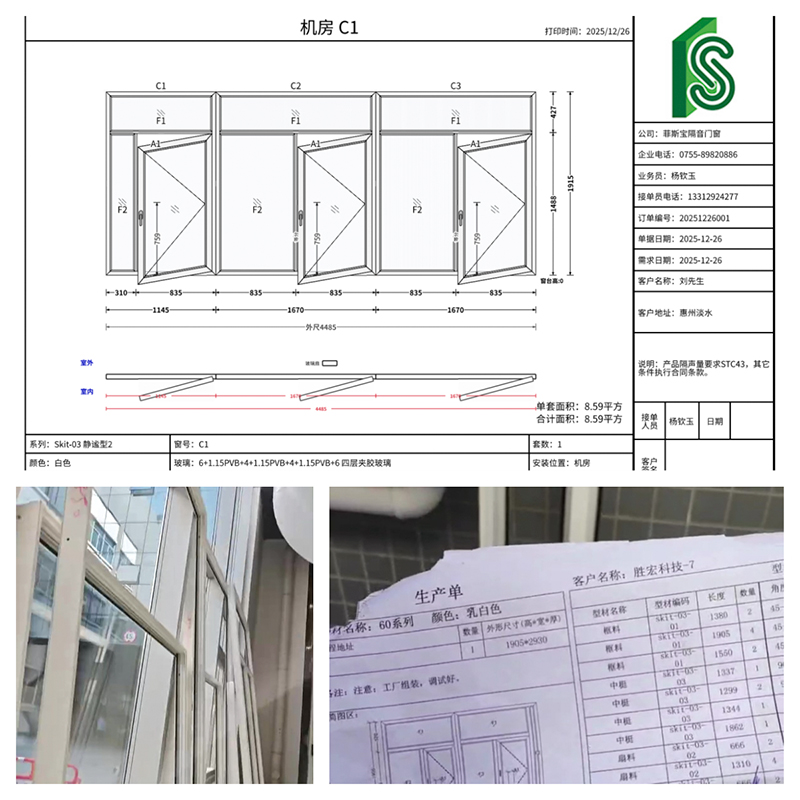
Option B: 6+1.14 PVB + 6 + 12A + 5 + 1.14 PVB + 5 quad-layer laminated insulated glass
6. Hardware Components
“VOTE” brand hinges rated for 100 kg load
304 stainless steel transmission lock box
304 stainless steel locking points and keepers
304 anti-drop safety cables
“BODUN” expansion corner keys and self-leveling steel plates
Custom CNC-machined aluminum handles
EPDM foam composite sealing gaskets
7. Key Advantages
Flush-frame design with a maximum visible frame width of only 88 mm—comparable to a smartphone screen width.
Can be combined with:
Electric window openers for smart operation
Ventilation silencers for passive air exchange
II. Core Acoustic Principles
1. Sound Transmission Theory
Building windows behave similarly to thin plate sound insulation systems. Their acoustic performance follows characteristic resonance and coincidence effects.

2. Coincidence Dip Phenomenon
Thin plates exhibit reduced sound insulation at specific frequencies (resonance and coincidence dips). These dips are particularly relevant for:
Low-frequency engine noise
Mid-frequency road noise
High-frequency horn noise
Glass vibration is excited by sound waves, and when resonance conditions occur, sound transmission increases significantly.
3. Insulating Glass Air Gaps
Common cavity thicknesses (9 mm, 12 mm, 15 mm, 18 mm, 20 mm) all show coincidence dips in the 63–250 Hz range, which overlaps with typical traffic noise frequencies.
4. Resonance Frequency Formula
The resonance frequency of a thin plate depends on:

Where:
– thickness of the plate:
E – elastic modulus of the material (N/m²)
– thickness of the plate (m)
– surface density of the plate (kg/m³)
– length and width dimensions of the plate (m)
– arbitrary positive integers.
(Referenced from the Handbook of Noise and Vibration Control Engineering – Sound Insulation Section)
5. Key Insight for Buildings
Brick walls typically have resonance frequencies below 20 Hz (below human hearing range), meaning the weakest acoustic point in buildings is usually the windows.
Improving window insulation depends mainly on:
Increasing surface mass density
Increasing damping (loss factor η)
6. Structural Improvements
120-series frame uses ≥2.0 mm thick profiles
Multi-chamber structure equivalent to ≥8 mm effective aluminum thickness
Surface density ≥21.6 kg/m², estimated Rw ≈ 40 dB
7. Damping Enhancement
Multi-layer laminated glass (PVB interlayers) significantly increases damping and reduces vibration transmission.
Optional upgrades:
1.52 mm PVB or SGP interlayers
EPDM flexible sealing between glass and frame
8. High Glass Ratio Design
Glass accounts for 88–90% of total visible area, improving both daylighting and acoustic performance.
9. Triple Sealing System
EPDM foam sealing strips
Dense EPDM pressure equalization seals
Frame-wall sealing with minimal gaps (<5 mm="" preferred="">
Installation gaps >20 mm are filled with micro-expanding waterproof mortar.
III. Industry Overview
1. Limitations of Standard Double Glazing
Typical developer-installed windows (e.g., 5+9A+5) exhibit coincidence dips in low-frequency ranges (63–250 Hz), resulting in:
Low-frequency “humming” indoors
Strong vibration perception from trucks and traffic

2. Market Focus Gap
Most mainstream window brands prioritize aesthetics, hardware quality, and finish, but often neglect low-frequency acoustic performance.
3. Market Reality
Homes near highways or busy roads often experience price depreciation due to noise pollution. Many residents seek cost-effective acoustic solutions.
4. Cost Comparison
Premium acoustic systems: 2600–5000 RMB/m²
120-series ultra-slim acoustic windows: 1580–1680 RMB/m²
5. Material Efficiency Trend
With rising aluminum costs and carbon neutrality policies, efficient material usage is increasingly important.
6. Common Misconceptions
Many consumers assume “double glazing = soundproof,” or that thicker air gaps always improve insulation—both are incorrect for low-frequency noise.
7. Mass Law Principle
Lightweight materials cannot effectively block low-frequency noise; mass density is the key factor.
8. Material Myth Clarification
Sound insulation depends on surface mass density, not whether the frame is aluminum, PVC, wood, or composite.
IV. Product Advantages
1. Increased Daylighting
Compared with conventional 110/120 systems, visible light transmission increases by 8–12%.
2. Minimalist Aesthetic
Hidden sash design with clean façade appearance, requiring higher precision manufacturing and installation.
3. Ultra-Slim Design Metrics
Frame visible width: 40 mm
Sash profile: 63 mm
Maximum overlap area: 80 mm
4. High Mass Efficiency
Higher glass ratio increases overall surface density and improves sound insulation.
5. High Damping System
Uses multi-layer laminated glass with EPDM sealing and external silicone waterproofing.
6. Performance Ratings
Sound insulation: Rw (C; Ctr) = 45 (-1; -3) dB
Thermal insulation: U-value ≤ 1.8 W/(m²·K)
Wind resistance: up to Category 13 typhoon level (with reinforced mullions)
V. Applications & Target Users
Homes near highways, railways, airports, subways, construction zones, commercial noise areas
Renovation projects requiring modern minimalist aesthetics
Balcony enclosure with integrated living room expansion
VI. Acoustic Mass Law Explanation
Sound insulation depends primarily on:
Surface mass density × thickness
Formula:
R₀ = 10 log[1 + (π f M / ρ₀ c)²]
Where:
ρ₀ = air density (1.18 kg/m³)
c = speed of sound (344 m/s)
f = frequency
M = surface mass density
Example system:
6+1.14PVB+6+12A+5+1.14PVB+5
Surface density: ~57 kg/m²
Estimated insulation: ~45 dB (theoretical)
VII. Testing Results
Lab noise source: 80 dB(A) white noise
Installed with fully sealed mortar joints
Measured indoor level: 42.5 dB(A)
Frequency range tested: 100–5000 Hz

(Test report available)

VIII. Usage Notes
Requires ~120 mm installation depth
Designed for high-performance acoustic insulation (≈42.5 dB system rating)
Customizable: casement, top-hung, or electric opening systems
Can be combined with ventilation silencers or smart motor systems
IX. Summary
Through continuous in-house testing and engineering optimization, the design prioritizes:
Maximizing acoustic performance
Removing structural inefficiencies
Balancing cost and performance
Key principle:
Glass, not aluminum, is the dominant acoustic surface in windows. Increasing glass ratio and damping is critical for performance.
X. FAQ
Q: I live right next to a main road. When large trucks pass by, my windows shake. Will your windows make it so I can’t hear any noise at all?
A: That’s not possible—no window can make it completely silent.
If your home is within 50 meters of a main road and below the 7th floor, vibration from heavy trucks (through tire impact and road structure) can travel through the ground into the entire building. In such cases, you may even hear structural vibration when pressing your ear against the wall. This is structure-borne noise, and windows alone cannot solve it.
Even if your home is more than 100 meters away and above the 20th floor, it is still not possible to eliminate all sound completely. Human hearing becomes more sensitive in very quiet environments. When sound drops below about 32 dB(A), further reductions are not perceived as a big change in loudness due to auditory compensation.
A comfortable sleeping environment is typically around 35–40 dB(A) of pink noise. The goal of installing soundproof windows is to control indoor noise around this level. Multi-layer laminated glass with different thicknesses improves low-frequency sound insulation, helping the indoor sound become closer to broadband “pink noise.”
Q: If all are aluminum alloy thermal-break soundproof windows, why is your sound insulation better?
A: According to the Engineering Manual of Noise and Vibration Control – Sound Insulation Section, the acoustic performance of building windows mainly depends on overall surface mass, damping coefficient, and porosity.
As an acoustics-focused company, Fisbao Soundproof Windows applies noise-reduction principles in a targeted way. We select different glass configurations based on different noise characteristics, focusing on the root cause of the problem to effectively reduce noise.
Q: I already have double-glazed insulated windows. Would replacing them with yours make a big difference?
A: Yes, the improvement would be significant.
Standard double glazing mainly improves thermal insulation and performs well for high-frequency noise. However, for low- and mid-frequency noise such as tire noise and engine rumble, resonance can occur (the “coincidence effect”).
Upgrading to multi-layer laminated acoustic glass significantly helps. The PVB interlayer in laminated glass effectively suppresses glass vibration amplitude, greatly reducing low-frequency “humming” noise.
Q: The window frame is so narrow—will large glass panels be unstable or prone to shaking?
A: No, they will not shake.
“Narrow frame” refers only to the visible profile width. Structural strength depends on the internal section design, not appearance. Glass stability depends on its own strength and the frame’s wind-load resistance.
Our ultra-slim windows use reinforced mullion structures to ensure sufficient wind resistance, especially important for high-rise coastal buildings.
Q: Will the ultra-slim frame reduce sealing performance and cause air or water leakage?
A: No. Airtightness and water tightness are not reduced.
Sealing depends on precision fit between movable sashes and frame gaskets, not frame width. We use EPDM foam rubber seals and add an extra EPDM pressure seal, forming a triple-seal system.
The sealing performance is equivalent to our G60 soundproof window series.
Q: For high-rise buildings, is the wind resistance of ultra-slim frames sufficient?
A: Yes, when equipped with reinforced mullions.
For exterior windows, large glass panels are embedded about 20 mm into the frame to prevent deformation under wind pressure. The mullion (the weakest point structurally) is reinforced by increasing its moment of inertia, allowing the system to withstand typhoon-level winds (Level 12).
Q: My house is old and the window opening is uneven. Can it still be installed?
A: Yes, that is not a problem.
We have installed windows in many types of buildings over the past 15 years, including older coastal concrete buildings where edges may crumble during demolition.
We use CC waterproof crack-resistant mortar for filling gaps between frame and wall. It slightly expands as it cures, helping seal micro-cracks and improving waterproofing.
Q: My home is already renovated. Will replacing windows damage walls or interior finishes?
A: We offer a non-destructive window replacement service.
Our professional demolition team uses cutting tools to minimize wall damage. After installation, we apply outdoor weather-resistant silicone sealant and indoor modified silane sealant to cover any demolition marks.
This allows same-day replacement and same-day occupancy without secondary renovation.
Q: A lot of noise comes through walls. Is replacing windows still useful?
A: In most standard residential buildings that meet national codes, wall airborne sound insulation is typically above 45 dB(A). In such cases, windows are usually the weak point.
Well-constructed walls generally do not transmit airborne sound significantly. If you hear sound when pressing your ear to the wall, or noise is stronger in corners and does not change when moving away from windows, it is likely structure-borne vibration rather than airborne transmission.
In our 15 years of experience, true wall insulation problems are rare and mostly occur in converted industrial buildings with hollow block walls. In those cases, window replacement alone would not solve the issue.
Q: Why are your ultra-slim soundproof windows more expensive?
A: Several factors:
Frame material: Although visually slimmer, the profile actually requires thicker and stronger structure, increasing material usage and cost.
Glass: For roadside environments, low-frequency noise is the main challenge. Multi-layer laminated glass (3 or 4 layers) is significantly more expensive than standard insulated glass.
Hardware: Large glass panels (45–60 kg/m²) require heavy-duty components. We use high-load 100 kg hinges and reinforced multi-chamber sashes with expansion corner connectors.
Measurement & customization: We use professional sound level meters to analyze frequency spectrum and design customized solutions, along with 3D simulation software.
Installation: Heavier glass increases transportation and installation difficulty, requiring more labor and higher risk management.
Q: What if the glass fogs up? What is the warranty period?
A: Pure laminated glass does not fog internally.
For triple-glazed laminated or multi-layer composite systems, we use integrated bending spacers with sufficient desiccant, sealed with butyl and neutral silicone. Under normal use, gas leakage does not occur for about 15 years.
We provide a 5-year warranty for the whole window and a 10-year warranty for insulating glass seals. Any fogging within the warranty period is replaced free of charge.
Q: Can window frame colors be customized? How do they match interior design?
A: Standard colors are off-white and dark gray.
In the Pearl River Delta region, over 80% of buildings use dark gray frames. Many property management rules require consistent exterior appearance, so most customers choose dark gray.
Custom colors are available at an additional cost of 100 RMB per square meter, with production time extended from 15 working days to about 25 working days.