 简体中文
简体中文 English
G40 Casement Soundproof Windows
High‑Performance Acoustic Solutions – Even on Narrow Sills
Product Overview
The G40 Series is a professional soundproof window designed for both add‑on installation (inside your existing window) and full replacement (removing old windows). It creates a powerful dual‑window system when combined with the original unit, delivering outstanding noise reduction with minimal space occupancy.
Dual‑window performance – original window + 8 cm air layer + G40 sealed unit → combined sound insulation >45 dB(A) , traffic‑noise spectrum correction Rw + Ctr ≥ 43 dB.
Acoustic principle – the 8 cm air layer significantly attenuates low‑frequency noise below 250 Hz. As the air gap increases beyond 12 cm, the coincidence dip shifts downward, avoiding the critical traffic‑noise band (63–250 Hz).
Profile – custom‑extruded 6063‑T5 aluminium, multi‑cavity, equal‑surface‑density design based on the Noise and Vibration Control Engineering Handbook (Ma Dayou). Wall thickness ≥ 1.8 mm.
Glass options –
6 mm + 1.14 PVB + 8 mm double laminated glass
5 mm + 1.14 PVB + 5 mm + 1.14 PVB + 5 mm triple laminated glass
Single‑window replacement – remove old windows and install G40 directly. Traffic‑noise spectrum correction Rw + Ctr ≥ 30 dB.
Hardware –
VOT hinges (load capacity 80–100 kg), 304 stainless steel transmission box, locking points, and anti‑drop cables.
BUDUN expansion corner brackets and self‑levelling steel shims.
Flexible custom CNC‑machined aluminium handles and EPDM seals.
Why choose G40? – occupies only 40 mm of sill depth. Available in inward‑opening, outward‑opening, tilt‑and‑turn, and top‑hung configurations. Can be paired with electric openers for smart operation or with our ventilation silencer for combined fresh‑air and noise control.
Core Acoustic Principles
2.1 Sound Insulation Behaviour of Thin Panels
Doors and windows behave similarly to typical thin plates in terms of sound transmission loss. The frequency‑response curve shows two coincidence dips – one in the low‑frequency region and one at higher frequencies.
For building fenestration, the primary coincidence dips occur at:
Low frequencies – engine noise, road rumble.
Mid‑frequencies – tire/road interaction.
High frequencies – horns and sharp noises.
When the bending vibration of the glass matches the incident sound wavelength (integer multiples), strong coupling occurs, allowing significant sound energy to pass through. Ordinary insulating glass units (with air spaces of 9, 12, 15, 18, or 20 mm) exhibit a pronounced coincidence dip in the 63–250 Hz range.
2.2 Resonance Frequency of a Thin Plate
The resonance frequency formula of a rectangular plate is given by:

where:
B – Bending stiffness of the plate:
B=1/12Et3
E – Elastic modulus of the material (N/m²)
t – Thickness of the plate (m)
M = surface density (kg/m²)
a,b = plate dimensions (m)
p,q = positive integers
For typical brick walls, the resonance frequency is below 20 Hz (inaudible). Therefore, windows are the acoustic weak link in any building. Improving window sound insulation relies primarily on increasing surface density and damping factor (loss factor η).
2.3 How G40 Achieves Superior Sound Insulation
Increased profile surface density – wall thickness ≥ 1.8 mm, 3‑cavity structure → equivalent solid aluminium thickness ≥ 5.4 mm → surface density ≥ 14.58 kg/m² → Rw ≈ 40 dB.
Enhanced damping – multi‑layer laminated glass + flexible connections between glass and frame. Our triple laminated glass uses PVB interlayers (minimum 1.14 mm, optionally 1.52 mm PVB or SGP). High damping effectively suppresses resonance and coincidence effects.
Maximised glass area – glass occupies 85–90 % of the total window surface, minimising the proportion of less‑dense frame area.
Dense centre seal – the opening sash is the weakest point in terms of surface density. Our triple‑seal design uses a compact EPDM gasket to improve both sealing and local surface density.
Minimised gaps – installation clearance between frame and wall is kept ≤ 5 mm. For gaps > 20 mm, we use micro‑expanding waterproof mortar.
Precision manufacturing – CNC cutting with diamond blades ensures dimensional accuracy of ± 0.5 mm, angle accuracy ± 0.3°, and on‑site vertical/horizontal alignment ± 1°. This guarantees high surface density and low porosity.
Industry Challenges We Address
Developer‑supplied windows – typical insulating glass (5+9Air+5) has a low‑frequency coincidence dip in the 63–250 Hz range, causing that persistent “hum” and rumbling sensation when heavy vehicles pass.
Mainstream window brands – focus on aesthetics, surface finishes, and branded hardware, but rarely consider acoustic coincidence dips or high‑surface‑density design. They target the premium market, not specialised roadside noise solutions.
Budget constraints – units closest to major roads are often sold at discounted prices. Homeowners who compromise on location usually have limited budgets for noise control. G40 was designed to maximise acoustic performance per dollar – making quiet living affordable.
Cost comparison – high‑end windows with excellent low‑frequency insulation cost 2,600–5,000 CNY/m². G40 costs only 1,250–1,380 CNY/m².
Demolition is often impossible –
Occupied homes – removing old windows damages waterproofing and interior finishes.
Curtain‑wall buildings (hotels, hospitals, offices) – exterior removal is prohibited.
Government‑subsidised housing – original windows cannot be replaced.
G40 can be added inside occupying only 40 mm, without altering the original window or structure.Misconception about insulating glass – many vendors believe wider air gaps equal better sound insulation. When users find it ineffective, adding a G40 as a second layer increases insulation by 20–30 dB(A) – a cost‑effective remedy.
Ineffective “soundproof” add‑ons – curtains, seal strips, and acoustic panels ignore the Mass Law – lightweight materials cannot block low‑frequency noise.
Misleading claims about materials – some sellers say “plastic steel doesn’t transmit sound, aluminium does”. In fact, according to the Noise and Vibration Control Engineering Handbook, sound insulation depends primarily on surface density, not on whether the material is metal or plastic. Steel is actually used in military soundproof windows because of its high density.
Unique Advantages of G40
15 years in the market – over 10,000 units installed. Simple design, failure rate ≤ 0.1 %, after‑sales rate ≤ 0.1 %. Extremely durable and reliable.
No demolition, no damage – add‑on installation occupies only 40 mm sill depth. Dry installation – no wall cutting, no damage to window frames, wallpaper, or trim.
Preserves original window functions – your existing window continues to provide weather and security protection.
Superimposed sound insulation – with outdoor noise at 60–70 dB(A), indoor levels drop to below 35 dB(A) .
Combined thermal insulation – the 8–12 cm air layer provides a thermal buffer. Typical performance:
Traffic‑noise spectrum correction Rw + Ctr ≥ 43 dB
Thermal transmittance U‑value ≤ 0.8 W/(m²·K)
No single‑layer window can match this dual‑window performance.Ideal for old‑building renovations – many old windows are 40‑series outward‑opening units. Replacing them with G40 fits the original opening, maximises usable sill space, and does not reduce indoor area.
Narrow‑sill champion – the G40 occupies the smallest sill depth of any casement window on the market. For large windows or balcony enclosures, optional reinforced mullions withstand typhoon‑force winds (Category 9) .
Applicable Scenarios & Target Users
Noise sources – flight paths, subways, high‑speed rail, highways, main roads, bus depots, construction sites, square‑dance areas, and commercial districts.
Specific applications – mechanical/electrical rooms, production workshops, recording studios, home KTV, hotels – any space requiring sound containment.
Compatible window types – sliding, casement, bay, top‑hung, fixed – all can be retrofitted.
Ideal for –
Long‑term residents of noisy roadside homes who do not want to move or renovate.
Industrial noise‑control projects.
Entertainment venues needing to meet boundary noise limits.
New homeowners who cannot adapt to a noisy environment.
Factories failing environmental noise assessments.
Old‑building renovations – replacing all windows.
Balcony enclosures with high acoustic requirements – connecting living room to balcony for extra space.
Theoretical Calculation – The Mass Law
Sound transmission loss through a panel is governed primarily by its surface density (thickness × density). Other parameters contribute only about ± 10 %.
For normal incidence, the theoretical sound insulation R₀ (dB) of a homogeneous single panel is:
R0=101g[1+(πfM/ρ0c)2]
Where:
ρ0= air density (1.18 kg/m³)
c = speed of sound in air (344 m/s)
f = frequency (Hz)
M = surface density (kg/m²)
For our triple laminated glass 5 + 1.14PVB + 5 + 1.14PVB + 5, surface density ≈ 40 kg/m².
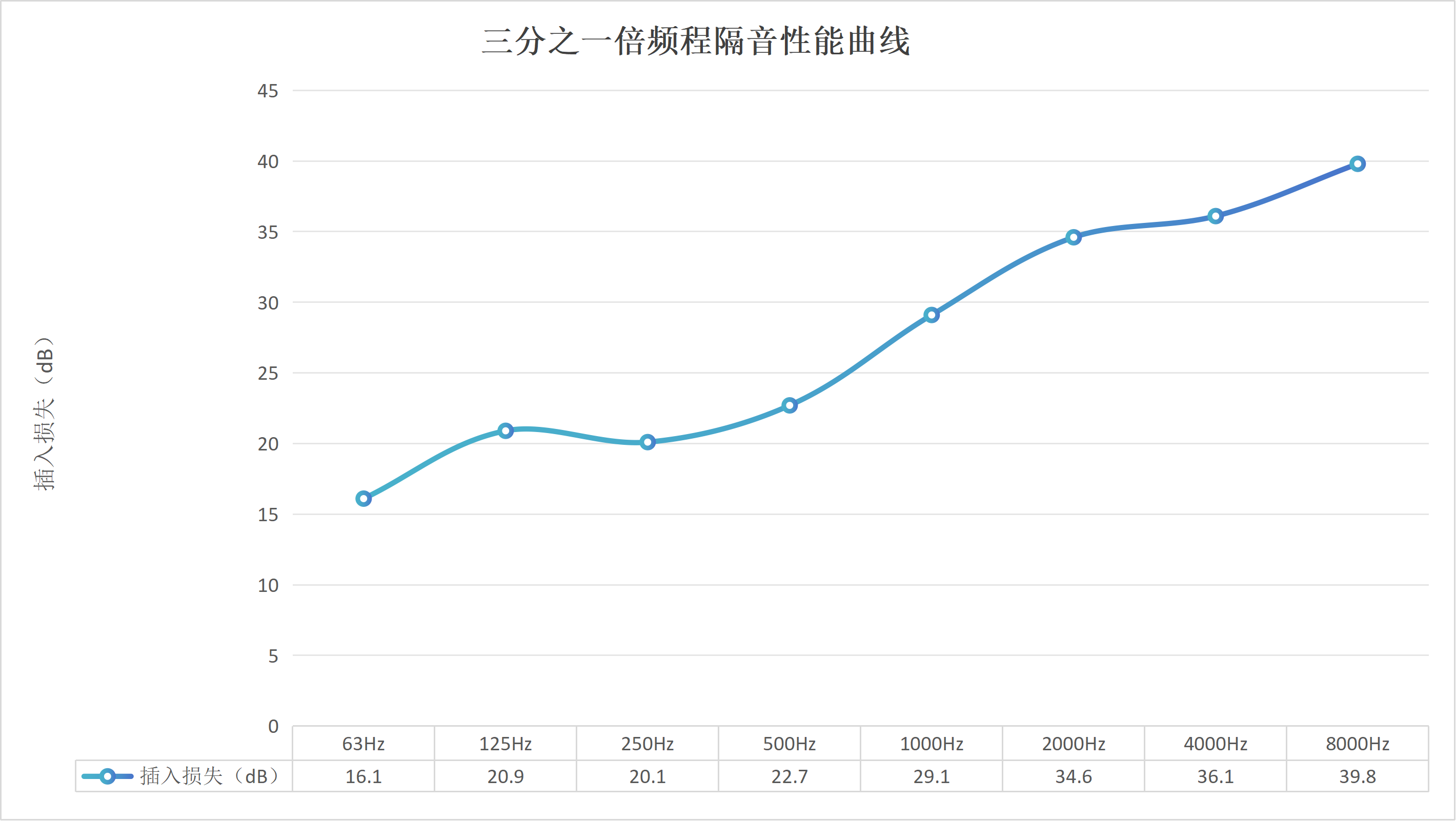
Theoretical single‑window insertion loss ≈ 38 dB(A).
Laboratory Test Results
Test signal: steady‑state white noise at 80 dB(A).
Installation: frame sealed with cement mortar to eliminate flanking paths.
Measured A‑weighted sound pressure level: 33.5 dB(A).
Note: This is the single‑window A‑weighted insulation, not the combined double‑window traffic‑noise correction (Rw + Ctr).
Usage Instructions
Add‑on installation – occupies only 40 mm sill depth. Combined with your original window, traffic‑noise spectrum correction Rw + Ctr ≥ 42 dB.
Replacement or balcony sealing – single‑window traffic‑noise spectrum correction Rw + Ctr ≥ 30 dB. The narrow frame offers a sleek, minimalist look.
Customisation – available as inward‑opening, tilt‑and‑turn, outward‑opening, or top‑hung. Can be paired with our ventilation silencer for fresh‑air supply or with electric openers for smart control.
Summary & Philosophy
Through 15 years of in‑house R&D and continuous optimisation, we have refined the design while reinforcing weak acoustic points. By thickening critical materials, we eliminate every “sound‑insulation short board.” This pursuit of the optimal quality‑cost balance is why Flexible windows' products remain highly cost‑effective.
For any window, the glass area dominates the total surface – and its surface density far exceeds that of the frame. Maximising the glass area and embedding it deeply into the profile is the key to reducing flanking transmission.
The measured A‑weighted value (33.5 dB) closely matches the theoretical prediction (38 dB), confirming that our design and manufacturing processes are near‑perfect.
Frequently Asked Questions
Q1: Higher sound insulation means higher price – is that true?
A: Generally, yes. Achieving higher surface density and damping requires thicker profiles, thicker laminated glass, and tighter seals. However, adding a second layer (G40) gives far better performance than a single high‑end window at a much lower cost.
Q2: Isn’t quieter always better? Can you get down to 20 dB?
A: Not necessarily. The most restful environment is a steady, low‑level pink noise around 30–40 dB(A) – like rain or fan hum. For roadside homes, dropping below 30 dB(A) is extremely difficult because structure‑borne vibration from traffic typically generates indoor noise in the 25–45 dB(A) range, concentrated in the 20–250 Hz band. Even with A‑weighted levels below 35 dB, the low‑frequency energy (50–65 dB at 50–125 Hz) can still feel very uncomfortable. We aim for an NR rating of ≤ 35 dB for a truly comfortable environment.
Q3: Can I use my phone’s noise‑measuring app? Is it accurate?
A: No. Entry‑grade professional meters cost around 5,000 CNY; those with 1/3‑octave analysis cost over 10,000 CNY. Phone microphones are dynamic‑type and vary widely between apps and devices. They are only useful for rough qualitative checks, not for quantitative measurement.
Q4: Does plastic steel really block sound better than aluminium?
A: No. According to the Noise and Vibration Engineering Handbook, with the same glass and sealing, sound insulation depends on surface density, not on whether the frame is metal or plastic. UPVC has a density of 1,350–1,460 kg/m³, while aluminium is 2,750 kg/m³. Plastic steel profiles are hollow with steel inserts only in cavities – not solid. About 4 mm of UPVC equals 2 mm of aluminium in terms of insulation. While some multi‑cavity UPVC windows outperform standard aluminium, they still fall short of dedicated acoustic aluminium profiles like ours.
Q5: Why does fan noise at 40–45 dB(A) feel fine, but traffic noise at the same level feels terrible?
A: A‑weighting heavily de‑emphasises low frequencies (e.g., –30.2 dB at 50 Hz, –8.6 dB at 250 Hz). Fan noise energy is mostly above 125 Hz, so the A‑weighted reading matches your perception. Traffic noise is concentrated in the 50–125 Hz range – even if A‑weighted shows 40 dB, the actual low‑frequency sound pressure may be 70 dB. Your body feels that energy, causing the “hum” that is hard to tolerate – because the human body’s natural frequencies (2–50 Hz, with internal organs at 4–12 Hz) resonate with these low waves.
Q6: My sill is only 4 cm wide – most vendors say they can’t install a casement soundproof window. Can you really do it?
A: Absolutely. This is our patented core technology. Traditional casement frames are 6.5–12 cm wide. We developed an ultra‑narrow frame that requires only 4 cm sill depth – the slimmest casement soundproof window on the market, designed specifically for narrow sills.
Q7: Is a 4 cm sill deep enough for secure installation?
A: Yes – we’ve been doing this for 15 years. For sills as narrow as 1–3 cm, we add aluminium square tubes and fasten directly to the wall. For 4–6 cm, we drill angled holes into the thicker wall structure, allowing nylon expansion anchors to bite deep. For replacement or balcony installations, sills are typically 10–24 cm wide – we centre‑mount for maximum stability.
Q8: Doesn’t a narrow frame mean thinner structure and poorer sound insulation?
A: No – sound insulation depends on surface density, not frame width. Our multi‑cavity frame has a wall thickness ≥ 1.8 mm, giving an equivalent solid thickness of 8 mm. The triple or quadruple laminated glass has a solid core thickness of about 20 mm, plus multiple PVB damping layers. The design eliminates acoustic weak points – it may look slim, but it is exceptionally “dense” and performs superbly.
Q9: What’s the process and lead time?
A: Online/phone inquiry → free on‑site measurement (dimensions and noise) → proposal and quotation → contract with 50 % deposit → production → installation. Total lead time is typically 20–25 days (extended in rainy weather for replacement jobs).
Q10: When measuring roadside noise with A‑weighting, does it truly reflect indoor annoyance after windows are closed?
A: No. We use the AWA5688 spectrum analyser to measure 1/3‑octave bands. With ordinary windows closed, noise above 1,000 Hz drops dramatically (to 30–45 dB), but 63–500 Hz levels often remain at 50–55 dB – only 6–10 dB lower than outside. That’s why we use the NR (Noise Rating) curve for target setting. We aim for NR ≤ 35 dB after installation, which truly addresses the discomfort caused by low‑frequency traffic noise.
Q11: How big is the difference between adding an ordinary window and adding a professional soundproof window?
A: Huge. Our acoustic engineers analyse the noise spectrum and your expectations to recommend the right glass and configuration – and we guarantee the result in writing. Ordinary installers work by guesswork – often achieving less than 10 dB(A) reduction. Professional soundproof windows typically deliver 20–30 dB(A) improvement.
Q12: What decibel level can you guarantee after installation?
A: Based on your noise spectrum and window size, we recommend a configuration that typically brings the 10‑second average indoor level below 35 dB(A) – regardless of how noisy it is outside. We put this guarantee in the contract: if we don’t meet it, you don’t pay.
Q13: Do you charge for on‑site measurement? What tools do you use?
A: Measurement is free. We use a tape measure for dimensions (accuracy ±1 mm) and an AWA5688 spectrum analyser for noise.
Q14: Why do you use a tape measure instead of a laser distance meter?
A: Laser meters often give readings 1–3 mm too large – they can’t tell if the beam is perfectly horizontal/vertical and frequently error on shiny surfaces (tiles, glass). For our required ±1 mm accuracy, a steel tape is more reliable.
Q15: Is add‑on installation considered unauthorised construction? Will property management object?
A: No – it’s like installing a TV or wardrobe. Indoor additions are private property rights. In 15 years, we’ve installed in every type of housing – public rental, talent housing, apartments, dormitories, and commercial units – without any issue.
Q16: How long does it last? Will sound insulation degrade over time?
A: We use silicone seals (purity ≥90 %) and EPDM (raw rubber ≥40 %) that remain flexible and effective for over 20 years. In 2026, we revisited users from 2011 – their seals were still in excellent condition. The sound insulation lasts as long as the window itself.
Q17: How much does add‑on installation cost? Compared to full replacement?
A: Add‑on installation averages 800–1,100 CNY/m², achieving dual‑window insulation >40 dB(A). A single replacement window with >40 dB performance costs 1,600–2,200 CNY/m², plus 500–1,000 CNY for wall repair.
Q18: Any hidden fees? Are measurement and installation charged extra?
A: No. We have transparent pricing on Taobao, JD, and Douyin. A 99 CNY measurement deposit is refundable if you don’t proceed. Installation is included in the contract total – no surprises. We discuss any site challenges (stairs, parking, obstacles) upfront and never add charges later.